

In November, large shoals of herring migrate into northern Norway’s fjords, attracting sizable pods of killer, humpback, and fin whales in their wake. Every seven years, a new dominant generation of herring selects the location where they will spend the winters in the years to come. During recent years, this was the Kvænangen fjord, instantly turning Tromsø and the small town of Skjervøy into whale watching hotspots.
While one could opt for a day trip to witness these massive and awe-inspiring mammals, I would argue that doing so would be a missed opportunity. Besides whale watching, the fjords of Troms and Finnmark are also home to some of Norway’s most majestic landscapes. The surrounding mountains already wear their winter coat. The sun stays low, providing just us a few hours of light before the fjords fade into twilight again. This ever-changing canvas simply demands a lengthier observation.
I had visited northern Norway in winter several times, but exploring it by sea was something that was still high on my list. When my dear friends Jan and Ane initiated their winter sailing expeditions, I eagerly joined them. A week aboard their sailing yacht Ursa Minor provides a unique chance to immerse oneself in the Arctic marine environment while anchoring in secluded, tranquil spots. Waking up to witness the white-capped mountains gradually brighten against the vivid blue sky before setting off for a day of whale watching is simply magical. Jan and Ane offer an outstanding and memorable experience, culminating in a final anchorage at their family island, Gjøssøya.
Over the past years, I was fortunate to document three winter itineraries with s/v Ursa Minor, sharing remarkable moments in the most stunning conditions. I am proud to showcase some of them through this story.
Welcome aboard s/v Ursa Minor. The journey awaits.

Navigating the Arctic
Navigating northern Norway’s waters during the winter months demands not only technical skill but also a thorough comprehension of the unique challenges of the Arctic maritime environment. Journeys at this time of year are often characterized by extreme weather conditions, including rapidly changing winds, potential snowstorms, and limited daylight hours.

The foremost concern when planning such a voyage is the unpredictable weather. November in the Arctic Circle often brings harsh conditions, with gale-force winds and rapidly shifting weather patterns. These factors can significantly affect the safety and efficiency of the journey. An overview of sheltered anchorages and harbors is key to keeping options open along the way and anticipating the unexpected.
As a result, no two routes are ever alike and even the final destination, the Klaudiussen family island Gjøssøya, is never a guaranteed stop.

En route
Weather permitting, sailing from Tromsø to the Kvænangen fjord takes roughly a full day. Along the way, we pass some of northern Norway’s most impressive mountains, including the Lyngen Alps.

There is plenty to do on board. You can help sailing, climb the mast or sit on the bowsprit and simply watch the landscape pass by. Stark mountains capped with winter’s first layer of snow. Fishing vessels floating on endless horizons. Seemingly everlasting twilight. The occasional fly-by of a petrel.
What’s not to like?


However, for some, these first nautical miles present a struggle as conditions can quickly become rough. The rocking of the ship is simply not everyone’s cup of tea. In practice, however, this always turns out to be a temporary nuisance. Shortly after, these initial discomforts will be forgotten, and everyone enjoys the journey to the fullest.
By November, daylight is already limited. The sun might rise at about 9:30 a.m. and dusk arrive around 1:30 p.m. Twilight gives us a longer window to work with, but we still need to make the most of these fleeting hours. It does not take long to settle into that routine though.

Yet, as the days shorten, the evenings lengthen. These nights are filled with captivating stories, heartwarming meals, and casual drinks. Then there is this on specific dice game, familiar to anyone who has traveled with Jan and Ane before. It holds a peculiar place, both beloved and forsaken, among the returning guests of Ursa Minor and the Huskylodge. It has spun its own collection of mythical stories.
As the night unfolds and the interior slowly turns quiet, the soft clinking of the anchor chain takes over, adding a subtle melody to the charm of the evening.
Among the whales
Anticipation crackles in the air as eager eyes scan the horizon. In search of spouts, the telltale signs of whales breaking the surface. The sense of anticipation builds, fueled by tales of previous encounters and the promise of nature’s grand spectacle that’s about to unfold.


Hearts quicken as the boat cuts through the chilly waters towards the first distant sighting. The excitement among the passengers is palpable as they keep their eyes trained on the location of the spout. Will we be able to catch up with it before it dives back under?
Suddenly, a collective gasp escapes the passengers as a spout pierces the stillness, a plume of mist rising in the cold air. The first sighting triggers a wave of euphoria, with exclamations and awestruck whispers echoing across the deck.

The sight of humpback whales gracefully breaching the surface, their massive bodies curving through the waves, is one to behold. These gentle giants exhibit a serene beauty as they glide effortlessly through the waters. They consistently leave their spectators in awe as they flash their unique flukes before diving back into the depths of the fjord, to later surface again in a yet unknown place.
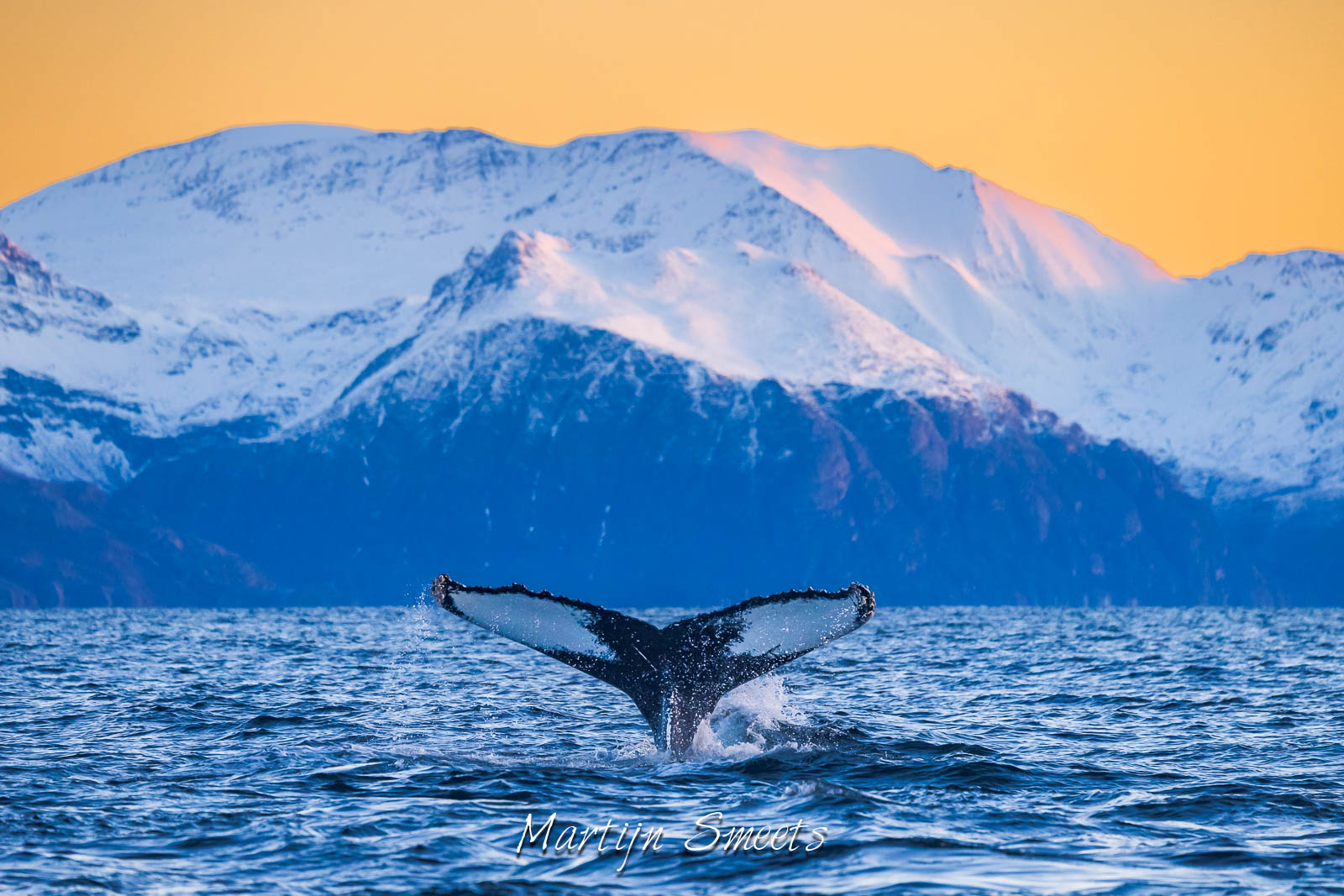


Contrastingly, the appearance of killer whales brings an electrifying energy to the scene. Known for their striking black and white markings and intelligence, these predators command respect. Witnessing a pod of killer whales gliding alongside the boat while feasting on herring is truly special.


Sailing the majestic Kvænangen fjord in northern Norway is an unparalleled experience, especially when graced by the presence of these awe-inspiring mammals. It provides a rare opportunity to witness the harmony and diversity of marine life in Arctic waters, but it is also a gentle reminder of the responsibility to protect and preserve these habitats for future generations.
A Moment of a Lifetime: a Breaching Whale
On every whale-watching occasion, I had hoped for a breaching whale and, of course, a chance to capture it. Yet, until now, that dream remained unfulfilled. I had never witnessed a breaching whale, let alone had the chance to photograph one. Until now.
Before this spectacle unfolded, we had already been treated to a morning full of incredible whale sightings. We were quietly observing a big pod of humpbacks gliding through the fjord when this giant suddenly surfaced from the depths. By coincidence, my camera was aimed in the right direction, but my settings were off. I quickly raised the ISO to get a faster shutter speed, moved the focus pointand switched to continuous shooting. All while hoping not to miss the moment. I somehow managed to make all these adjustments within that sole fraction of a second.
Click. Click. Click.
“Did you get it?” someone asked behind me.
“I think so,” I replied. I was not sure yet.
I hurriedly reviewed the images on the camera. There it was: a picture that surpassed even my wildest dreams.

Humpback and fin whales
Several different whale species roam these Arctic waters during the winter months. At first, telling some of the whale species apart can be difficult. Humpbacks and fin whales, for example, may look similar when only a small part of their backs is visible. After a few days of watching them, the differences become easier to spot.
One of the most noticeable differences lies in their size and appearance. Humpback whales are known for their robust bodies. This is most prominent by the varyingly shaped dorsal fin that sits atop their fleshy hump on the back. They also have long pectoral fins and the iconic knobbly head. The markings on their tails are distinctive enough for researchers to identify individual whales.
Fin whales, being the second-longest species of whale after the blue whale, are sleeker and more streamlined. Their body shape is marked by a tall, much more prominent dorsal fin. Their dives also look different. Humpbacks often lift their tails above the water before diving, while fin whales rarely do.


These species also behave differently from one another. While humpbacks almost always flash their flukes before they dive back under, fin whales hardly ever do. Humpback whales are known for their acrobatics and impressive aerial displays, like breaching and slapping the water with their fins and tails. Their most commonly used feeding technique is known as bubble-net feeding: creating underwater nets of bubbles to trap and corral small fish. In contrast, fin whales have a more straightforward approach to feeding. They engulf vast quantities of water with prey in a single, swift movement, filtering out small fish and krill through the baleen plates in their mouths.
Learning these differences adds another layer to whale watching. You begin to recognize more of what is happening, rather than simply waiting for the next whale to appear.

Climbing the mast
For those who are unafraid of heights, climbing the mast while the ship is at sea is an experience of its own. Even in relatively calm conditions, the movement feels much greater as you get farther above the deck.
After leaving the safety of the deck, carefully secured, of course, each step increasingly feels like a balancing act with the wind. The creak of the rigging, the gentle sway of the boat, and the rush of salty air all add to the adventure. With each upward climb, the vessel’s movement becomes more pronounced. It’s a constant reminder of the dynamic forces at play on the open sea, even in these relatively calm waters. There is no turning back though: you boldly stated that you would climb the mast and all fellow passengers are now closely following your steps to the top.
Once up at one of the mast’s platforms, the rush of adrenaline and excitement slowly fades away. As calmness takes over, the beautiful panorama reveals itself. A downward glance offers an unexpected view of the ship, seemingly miniaturized within the greatness of the open sea.


On Gjøssøya
Is there a better way to finish off a week of seafaring adventures than anchoring at a secluded island you can call your own for the night?
Probably not.
When the weather allows, Ursa Minor charts a course along the outer coastal route to anchor between Vengsøy and Gjøssøya. After a week at sea, the cherished island of the Klaudiussen family makes a welcome final stop. Here, one of the cabins provides a cozy retreat within the dramatic Arctic landscape, its interior echoing the memory of past generations.
The visit to Gjøssøya provides plenty of time for visitors to uncover the island’s surprising features such as its two caves, various great viewpoints and what appears to be the washed-ashore boiler of a steamship’s engine room. Those who prefer not to stray too far from the cabin can engage in collecting interesting seashells or simply unwind within the comforting warmth of the sauna.

For most visitors to Gjøssøya, the four resident reindeer are the true highlight of their visit to the island. The former stars of the Bardu Huskylodge reindeer trekking now amble curiously alongside the hikers, occasionally pausing to strike a pose within the picturesque scenery.


Whatever the program, the time spent on the island is a welcome contrast against the grandeur of the breathtaking landscapes and wildlife experienced during the week at sea. It offers a glimpse into the beauty that exists beyond the panoramic vistas: a world where the smallest details and joys tell their own story. The echoes of the whales and their majestic surroundings still resonate, but they are now intermingled with the soft whispers of tranquility and simplicity.
As night falls, the dark sky becomes the stage for the mesmerizing dance of colors that is the northern lights. The aurora gracefully weaves behind the neighboring peaks of Vengsøy, gently putting the icing on the cake of a spectacular journey.


You can watch more of my photography of Northern Norway here: selection of photographs of Northern Norway.
This story and its pictures is based on the following three journeys with s/v Ursa Minor:
- November 13–20, 2022
- November 11–18, 2023
- October 25–31, 2025
Interested in joining a sailing or dog sledding expedition in northern Norway? Head to the website of Ursa Minor Adventures / Bardu Huskylodge for more information.