

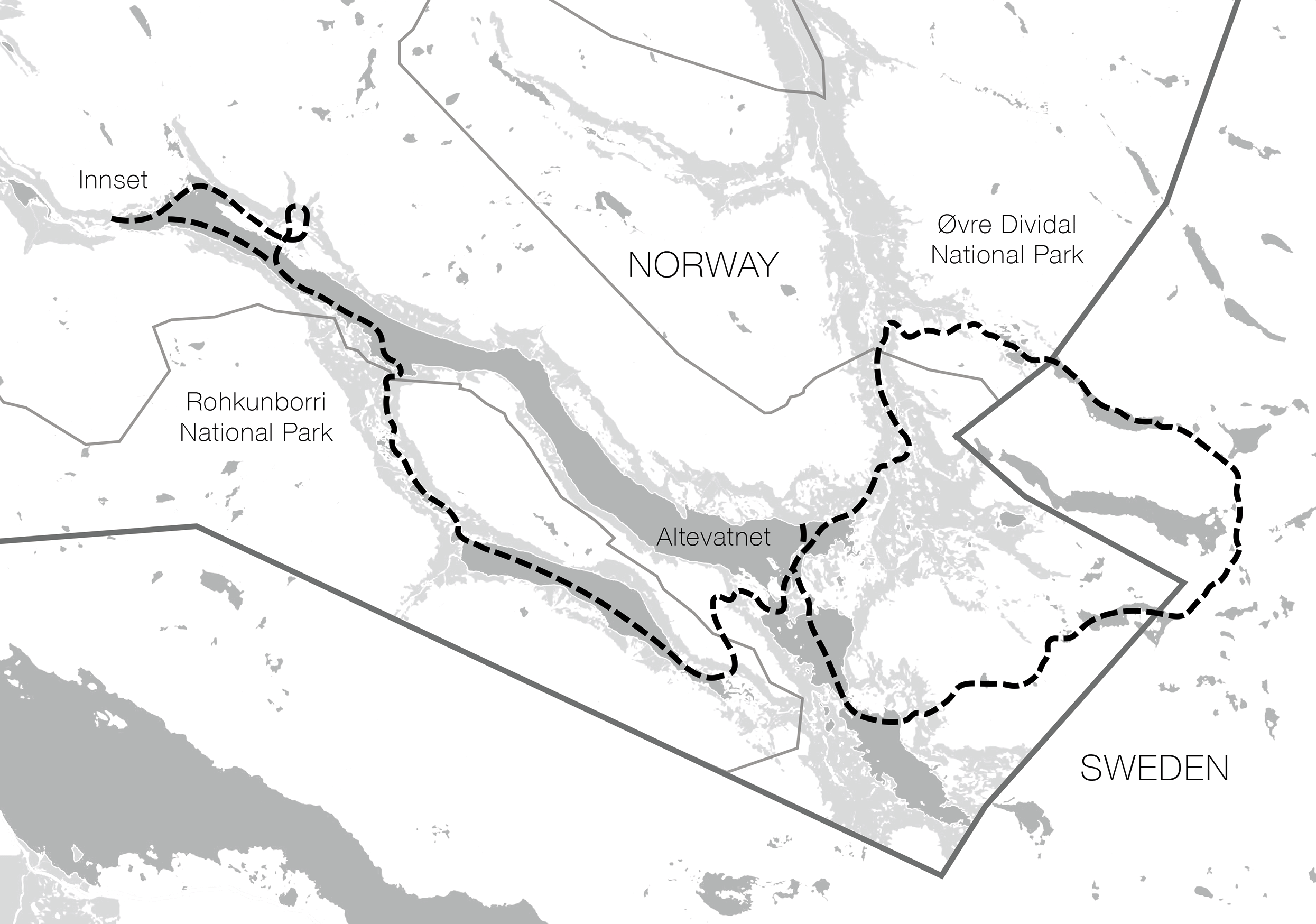
In February of 2020 we went on a dog sled trip in the far north of Norway and Sweden. For eight days we traveled from hut to hut with our own team of Alaskan Huskies on a route took us through the wilderness of the national parks Øvre Dividal and Rohkunborri. This one week has forever changed our lives in more ways than we could have imagined.

It’s December 2020 as I write this, more than ten months after the expedition. There is a pleasant sigh in our living room. It is Ala, who has fallen asleep on her Christmas blanket a few meters away. She is our living memory of last winter’s dog sledding tour and the Bardu Huskylodge. As a two-year-old Alaskan Husky, she should have been in front of the sled for many more years. It turned out differently. Covid-19 and the ongoing measures have hit the Bardu Huskylodge so hard that Jan and Ane had to close their company this fall and look for families to adopt their remaining 65 huskies.
The Bardu Huskylodge
It was completely accidental that we stumbled upon the Bardu Huskylodge in the winter of 2018. Together with two friends of ours, my girlfriend Lieske and I were travelling through Norway and we needed a stopover on the way to Tromsø. Upon arrival at the Huskylodge, it was love at first sight. Three basic, but extremely cosy wooden cabins and an outdoor sauna amidst a dog yard with the most adorable and beautiful huskies. As a bonus, five playful puppies were running freely around the farm. It was impossible not to fall in love with Baffin, Barents, Bering, Hudson and Kara. After a great afternoon of dog sledding and two days of puppy cuddling we were completely sold. We knew that one day we would return for a proper dog sledding expedition and to see what had become of those puppies. That day came on the 31st of January 2020.
This is the story of our eight day wilderness expedition through the Rohkunborri and Øvre Dividal National Parks. Right there, in between the most amazing sunrises and sunsets, we experienced what it feels like to be ‘in the middle of nowhere’.
Before we dive in, I want to say “thank you” to Jan and Ane, who opened their house for us and made us feel part of their husky family. We enjoyed every minute we spent with them, whether it was playing games, sharing experiences or listening to their stories about the huskies and the lifestyle of dog sledding. Their dedication to their work and the love and care for the huskies is truly inspirational. They made us fall in love with the life of a musher. What we thought would be a ‘once in a lifetime experience’ became something more: we left the Bardu Huskylodge with a yearning to return to what now feels as our home away from home. “And what about those puppies?” you might ask. Well, they grew up to be some really good lead dogs! Four of them even joined us on this tour!
Day 1: The day of firsts
The two days prior to the tour were all about getting adjusted and learning the basics of dog sledding on a training tour. During Jan’s lovely homemade dinners we went through all the possible routes and safety procedures. We received the names of the dogs that would be pulling our sleds for the next eight days and learned the ten basic commands:
- “Stå stram”: stand still
- “Oké!”: start!
- “Stå!”: stop!
- “Stram op!”: tension the line
- “Kom igjen!”: focus!
- “Jobbe, jobbe, jobbe!”: work!
- “Flink!”: good dog!
- “Haw”: left
- “Gee”: right
- “Nei” / “Ikke”: no / don’t
The first tour day started off with collecting the huskies that were going to join us on the expedition. It was easier said than done. With their strength and enthusiasm it was quite a challenge to get the right dogs into the trailers. Besides, all 85 huskies on the farm were barking and jumping around; all eager to accompany us on tour. With one exception though: being afraid of the car, Barents had to be dragged out of his kennel.
After final checks and a one and half hour drive we arrived at Innset, the starting point of the tour. We unloaded the truck and packed our sleds for the first time. Fully loaded, each sled approached a weight of 300 kilograms, mostly due to the large amount of frozen dog food.


As soon as the sleds were ready it was time to unload and harness the dogs. The lack of experience and routine made us struggle with the ropes and carabiners, so it took some time to get the four sleds and 33 dogs ready in the midst of all the chaos of barking dogs.
But then it happened. After a short “okay” all the noise died down and the sleds started to move. We were on tour!

The first day of the tour was relatively easy. There was plenty of time to get used to the sled: finding a comfortable position, learning how to break and how to drink tea along the way. Moreover, we focused on getting the commands right and recognising the seven or eight dogs in front of us; quite the challenge when half of your team looks similar from behind!

It’s probably one of the biggest misconceptions of first time dog sledders: the idea that the sledding itself is the active part of the day. It is quite the opposite. The actual work starts as soon as the sledding ends.
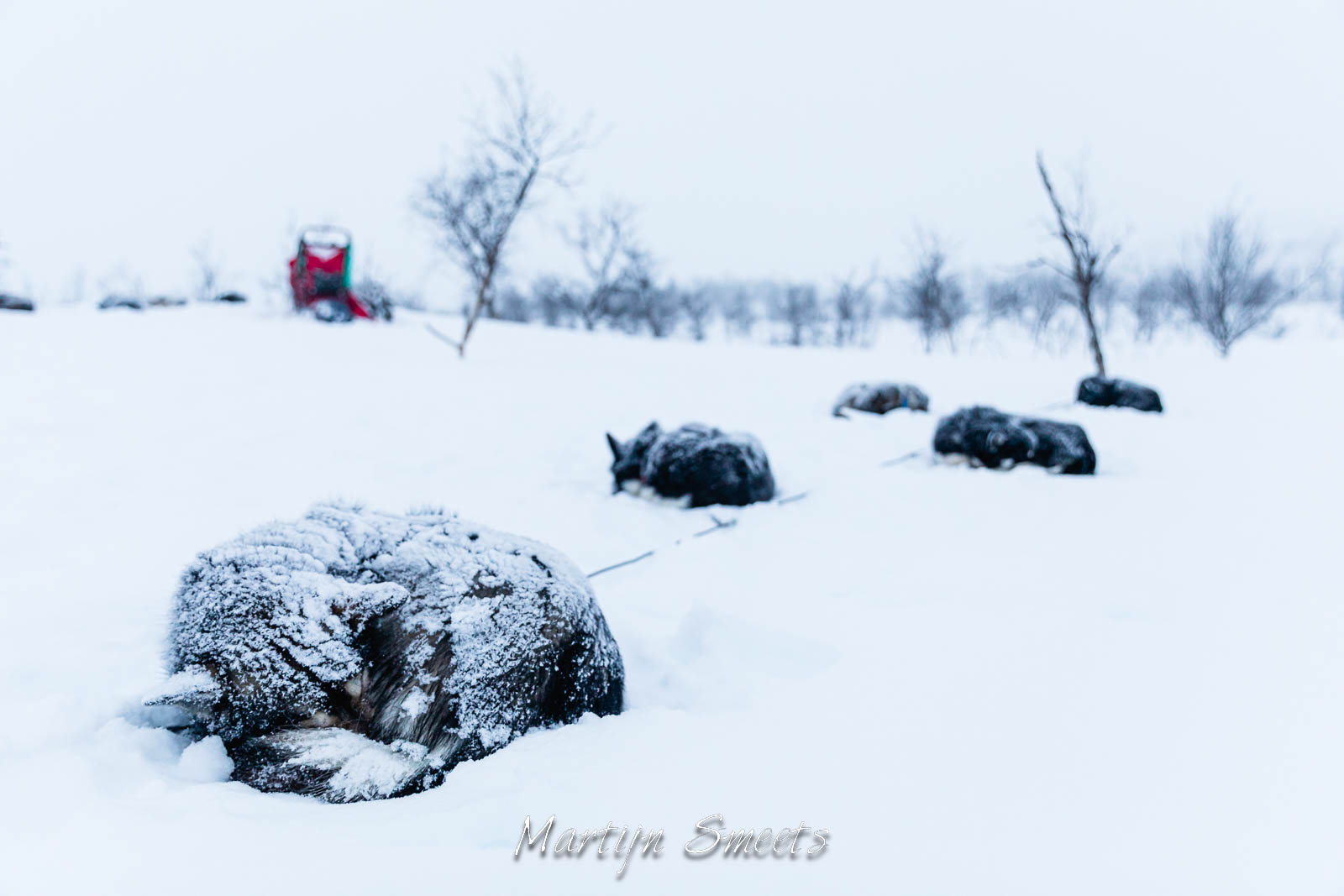
Upon arrival, nurturing the dogs is a first priority. All your huskies need to be cuddled, deharnessed and put to rest on the stake out line; potentially with a blanket.
With deep snow it can be exhausting to reach the cabin. You will also quickly learn that the shortest route isn’t necessarily the most convenient and that the detour is there for a reason. And sometimes you will stumble upon a cabin that must be dug out first.
Feeling cold? It takes some time to heat up the cabin, so heading out to the river or lake to get water is the quickest way to get warm again. Dragging 40 liter cans of water back through deep snow will fire you up in no time. And by the time you get back it’s probably time to feed the dogs again.
At the end of the day however, there is no better reward for all that hard work than enjoying a glass of whisky and one of Jan’s excellent meals inside a warm and cosy cabin.


Day 2: The long day
With a total of seven hours, this was the longest and most exhausting day on the sleds. The 53 kilometres long route led us over two lakes – Altevatnet and Geavdnjajávri – and two small climbs. The day ended under a moonlit sky. We had to use our headlamps to signal each other, while keeping the dogs motivated to make track through the deep snow.
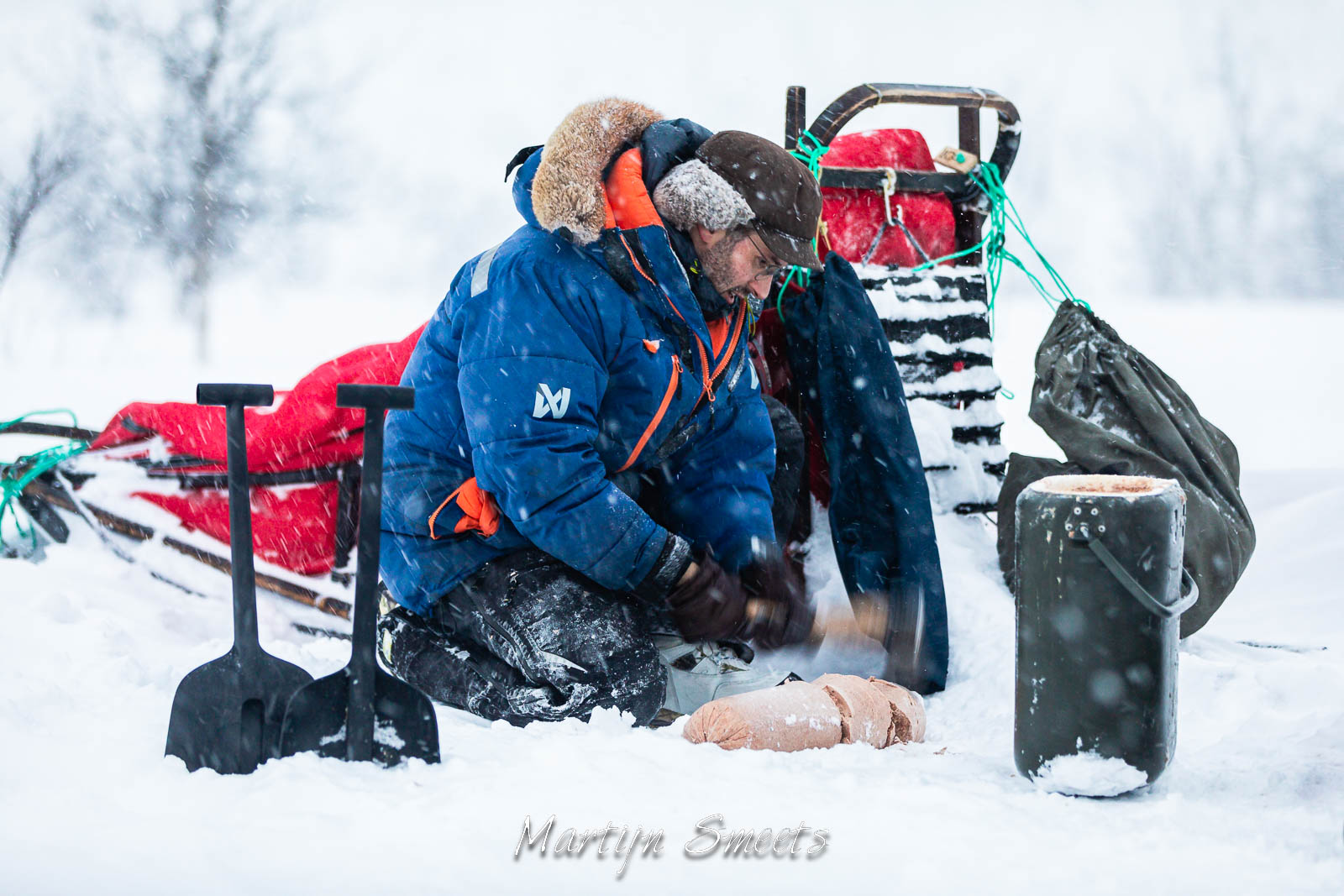


The cabin was placed a bit uphill from the lake. Bringing the dogs up through the deep snow wasn’t easy and this time we also had to put on the blankets for the first time. This went smoothly with most of the dogs, but not with my lead dog. Crispi had a blanket-related trauma, which required some patience. After the work was done, Jan’s reindeer stew was a real treat.
Cabin Life
Cabins along the route come in all shapes and sizes. There’s the big spacious one, with multiple rooms, a well equipped kitchen and (limited) electricity. And there’s the basic one with not much more than some beds, a kitchen sink and a wood oven. Everything else falls in between these two categories.
There’s one thing they all have in common: cabin life. Nights filled with whisky, games, stories and laughter. And often some more whisky. The early morning oven shift is probably the most magical part of cabin life. While everything is still perfectly quiet, the room slowly fills up with heat and the smell of fresh coffee.

For two nights we stayed at a cabin where dogs were allowed inside. Everyone was allowed to take one dog. We all brought our favourite ones: Ala, Castor, Juno and Embla. It was amazing to see how each dog clung to its musher. When Lieske settled on the couch, Juno (the smallest of the bunch) did not hesitate to crawl directly onto her lap. Only minutes later, they were both fast asleep.
Day 3: The cold day
This was the most challenging day. With temperatures dropping below minus 20 degrees centigrade, preparing the sleds and harnessing the dogs was tough. After an hour on the sleds, the wind kicked in and made it even colder. By the end of the day, the first signs of frostbite appeared.

The 31 kilometres long route was exceptionally beautiful though: vast empty landscapes under unearthly coloured skies. We scaled an 850 metres high mountain pass before descending to the lake Stuora Gámasjávri. There we crossed the border into Sweden. We spent the night in a basic Sami cabin at the edge of the lake. Without any proper trees we had to connect the dogs’ stake out lines to the sleds.
Creating compelling photographs during a dog sledding expedition isn’t easy. While on the sleds, the possibilities and variations in perspectives are limited; before and after the sledding the time and energy is limited. To make the most out of the available time, you will need to come well prepared with a pre-envisioned and thought out story as much as possible. Actually creating the images requires improvisation and swift action.
One of the shots I had envisioned for months was one of sleeping huskies under swirls of Northern Lights. While in general February and March tend to be the best months to see the Aurora Borealis in this region, we were not so lucky. Most nights were clouded and often we were simply too tired to try our luck and wait for the skies to clear. However, at the end of our evening at Kamas the sky suddenly opened up and not much later the first aurora showed. Since the dogs were sleeping in an open field, I realised that this would probably be the best opportunity for this shot. So even though the lights were still dim, I immediately put on some layers and rushed out with my gear. While the Northern Lights were getting more lively, the moon lit up the scene in front of me. Just a few minutes later, the lights died out and clouds rolled back in. It was long enough for me to take this photograph.

Day 4: The windy day
The fourth day of the expedition was the slowest of all in terms of pace: in 3 hours and 40 minutes moving time we travelled no more than 24 kilometres. It was mostly the rough wind that slowed us down. At times, the snowdrift made it hard to see the sleds in front of us and every now and then we could not even distinguish our own lead dogs. Luckily, the temperature was higher than the day before. Since we were now much more comfortable on the sleds, riding in these conditions was merely a spectacle.
Back in Norway we set up our tent within the Øvre Dividal National Park. The thought that we might very well be the only people within a 50 kilometre radius made us feel like we reached the middle of nowhere.


The tent night
Jan had already told us that for most people the tent night stands out from all other nights. For us this was no different. Nothing compares to enjoying warmth and cosiness, knowing that only thin sheets of fabric shelter you from the howling wind and blistering cold.
Setting up a tent in arctic conditions is a bit different than the usual summer camping. The snow needs to be flattened first; here the snowshoes come in handy. Next: the basic construction of the tent, which leaves no room for error in conditions like these. Setting up the tent’s guy lines while walking on snowshoes can be a challenge as well. By covering the edges of the tent with snow, it becomes properly isolated and protected from the wind.
While we were unpacking the sleds and digging up snow, Jan started heating the interior and boiling water. Without a lake within walking distance, we had to create water by melting snow. A time consuming process.
After all the work was done we ate an instant meal. It sure wasn’t bad, but simply could not compare to Jan’s pre-cooked dinners. We compensated with dessert: hot chocolate with a shot of rum. And then some more.
The combination of the stall sleeping bags on top of the reindeer skins made it a surprisingly warm and comfortable night. Except for our travel companion Florian maybe, who still had some wind coming in on his side of the tent.

Day 5: The brisk day
We woke up to a beautiful sunrise and quickly noticed that the wind had made some changes to the landscape in front of the tent. All dogs got snowed under, but it was particularly dangerous for Mille; she almost got buried in a wall of snow.


This day’s route took us through some forestry areas of the Øvre Dividal National Park. While moving through walls of snow, it felt like we were driving our sleds through a bobsled course. Some steep descents and bumps added to the adventure. This was also the day that our freshly gained confidence turned against us: we all tipped our sleds.
The best part of the day? Taking our favourite dogs inside the cabin!

Day 6: The fun day
The original plan for this day was to travel up to a mountain cabin. Instead, the heavy wind and slightly unpredictable weather in the mountain range made us decide to spend another night at our current cabin. And so we made a day trip through the same forest area as the day before. Without the need to pack the sleds it suddenly became a very relaxing day that started off with pancakes for breakfast.


Driving over previously made tracks with almost empty sleds made us reach top speeds. The favourable conditions in the valley even made it possible to fly a drone, which the dogs seemed eager to chase.
Needless to say, both for us and the dogs this day was all about having fun!
Driving a sled with these perfectly trained huskies is not difficult at all. You will quickly learn to use the brake to control the pace. There’s no need to worry about wearing down the dogs; for them it’s much better to keep moving slowly than to stop. Balancing the sled can sometimes be tricky, but will come naturally after a few days. The biggest challenge can be to keep on cheering and motivating the dogs, even when you yourself are at the end of your rope. It’s also important to correctly use the commands, as a lot of previous training can go to waste when the dogs get treated differently by their musher on tour.
At the start of the day, the dogs are full of energy and extremely eager to run. They are so incredibly strong; it’s not always clear who’s pulling whom from the stake out line towards the sled. To make sure the dogs don’t run off with the sled, it’s still tipped to its side and resting on the snow anchor. Once all teams are ready it’s time to lift up the sleds while holding the break. At this point the entire pack starts barking, howling and jumping. But as soon as you lift your anchor, loosen the break and give the signal “Okay!”, all the noise instantly dies out. The only sound that remains is the sliding of your sled and the soft treading of the dogs in front of you.
Due to the dogs’ energy and their necessary toilet breaks, the first hour of sledding is often the most intense part. Longer breaks are only meant for us humans; the dogs would rather keep on running. They can get really nervous and even during a perfectly calm break it only takes one wrong move to make the dogs go crazy. When that happens there’s no other option than to end the break.
Day 7: The easy day
Early morning cuddling in the cabin, toasted bread for breakfast and a spectacularly setting full moon during sunrise. The day could not have started any better.
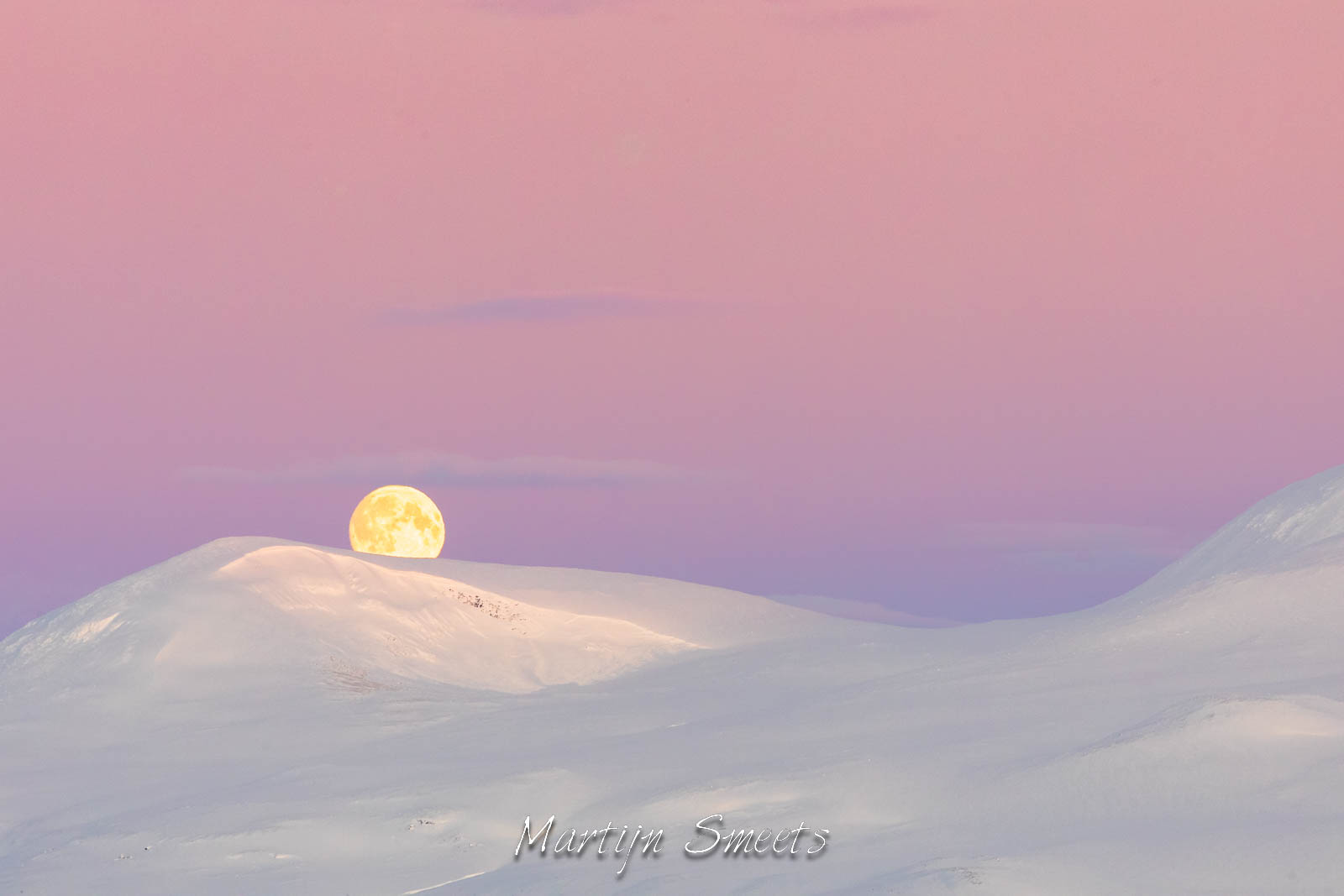
One might expect the full moon to cause some restlessness amongst the dogs and humans alike, but it was quite the other way around. This was by far the easiest day of the entire expedition. Everything went perfectly smooth and we were even able to take a surprisingly long break on the Geavdnjajávri lake.
We spent the night at a lavvu, a variation on the traditional Sami tent with a woodstove and an elevated wooden floor to sleep on. By now, this was all we needed for a good night’s sleep.

Day 8: The last day
All good things must come to an end. We were constantly aware that we were going through the morning routine for the very last time. The last oven shift. The last time feeding the dogs. The last packing of the sled. The last time harnessing the dogs. There was a shroud of sadness over this day. The only ones who seemed eager to travel the last stretch back to Innset were the dogs. We just wished we could have stayed in the wilderness a bit longer.


After a week out in the wild, being confronted with the first signs of civilisation was a disenchanting experience. First came the power lines, then the cabins and soon after the noise of snowmobiles.
It all ended as suddenly as it had begun.
What a difference a week makes. The first days we were still struggling with the names of our dogs and by now we could instantly recognise them. During the sledding, the feeding and the cuddling we had become familiar with all their little habits.
But the bonding with a dog team goes much further than that. We shared in their enthusiasm when faced with a fresh pile of snow and we cheered and motivated them when the conditions got tough. Often it seemed the bonding was mutual. Back at the Huskylodge we were allowed to bring Juno inside for the last night. She was Lieske’s favourite dog. But it could have also been the other way around: during the night Juno dragged her sleeping basket to the other side of the room to fall asleep against Lieske’s backpack.
After eight days it felt like these dogs were our own. Can you imagine how hard it was to say goodbye and leave them behind?
These were the 33 dogs that took us on tour:
- Jan’s team: Balder, Tillerot, Ala, Rohkun, Ecco, Snehetta, Ask, Kletten, Pasvik & Dirgi.
- Lieske’s team: Frøya, Hudson, Juno, Cassini, Barents, Njunis & Wallander.
- Martijn’s team: Crispi, Embla, Divi, Galileo, Bering, Reisa, Kalle & Rago.
- Florian’s team: Luigi, Mille, Baffin, Kamik, Jotun, Keppler, Castor & Skalli.

Unexpected life changes
Shortly after our expedition, Covid-19 rapidly spread across Europe. Norway soon after introduced strict measures and our expedition turned out to be one of the last of the season. The Bardu Huskylodge not only saw their turnover of the winter season go up in smoke, but also the basic income of the summer season disappeared like snow in spring. At the end of August we received the sad news that the Bardu Huskylodge was going to close after the 2021/2022 season. We quickly decided to book the last expedition and asked about the possibilities of adopting a dog. We were offered Ala: “perfect for apartment life” was Jan’s comment. We are still deeply moved that Jan trusted us with his favorite guide dog. And so the plan was born to take her to Rotterdam with our camper bus after the tour in April 2022 and to document her last ‘tour’.
Unfortunately, that documentary will not come. Norway has taken on even stricter Covid-19 measures. On November 8, we receive the inevitable message that the last winter season cannot take place either. Due to the rising costs, the dogs must be accommodated as soon as possible. And so we find ourselves in Kiel on December 5th, waiting for Jan and Ane who will then hand over Ala and 8 other huskies to their new owners.
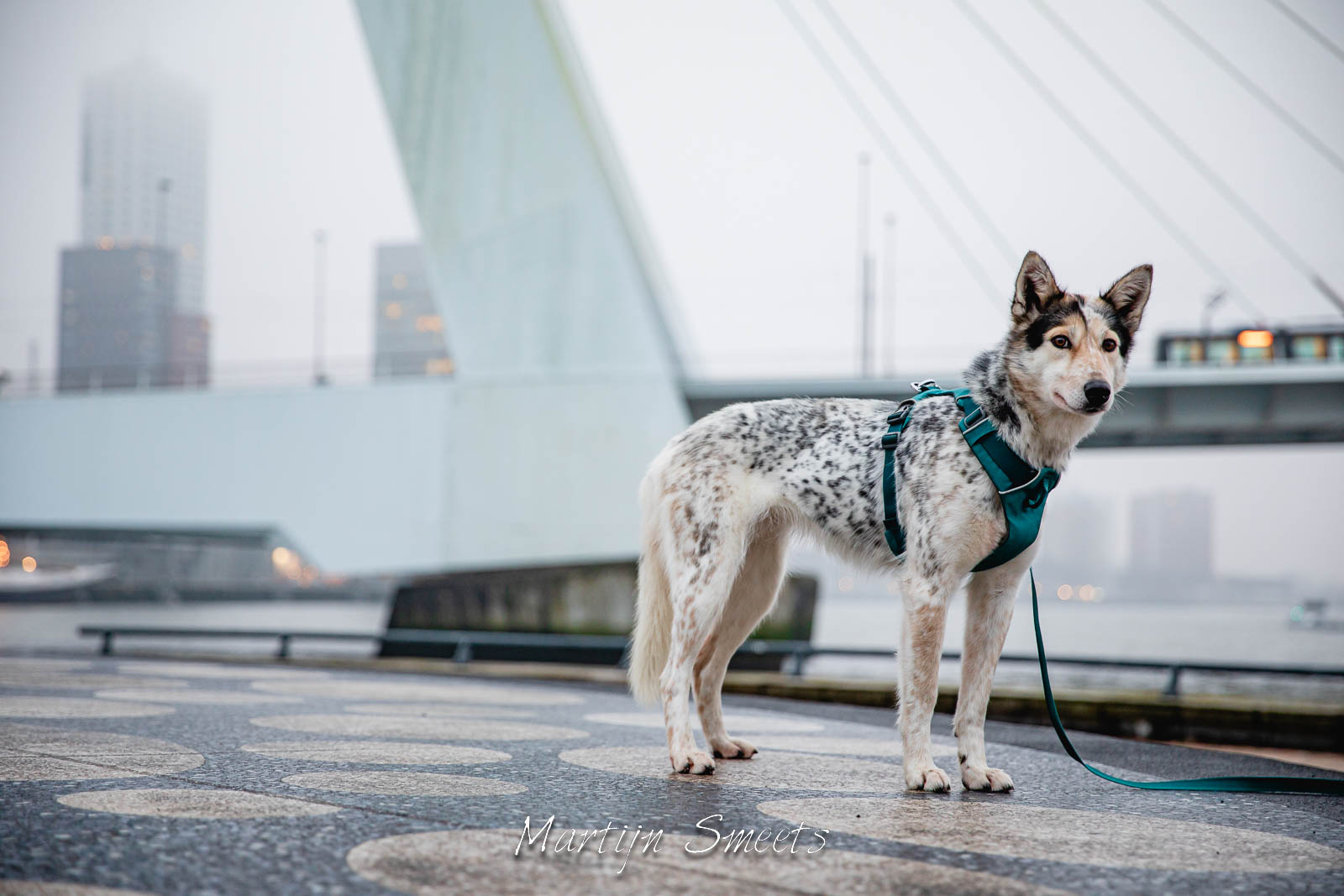
Now, more than three weeks later, it’s almost as if she was always here. We fully enjoy her gentle character and the rides we take with her in front of the dog scooter, where she already lives up to her image as a guide dog. But if we could choose, we would have wished her (and Jan and Ane) a long life in front (and on) the sled.
With the photography of this expedition I created the photography book: DIVIDAL – a dog sledding expedition with Bardu Huskylodge. In retrospect it is a document of one of the last expeditions of the Bardu Huskylodge.